
In modern industrial operations, lifting and transporting heavy loads with precision and safety is a vital requirement. Among the workhorses of manufacturing, steel, shipbuilding, and power generation industries, the 50-ton bridge crane stands out for its ability to handle exceptionally heavy materials efficiently. However, managing such massive loads safely requires more than just strong structural design; it demands an intelligent control system. Programmable Logic Controllers (PLCs) have become the backbone of advanced bridge crane systems, providing precise operation, real-time monitoring, and enhanced safety. This article examines how PLC-based control ensures safe load capacity handling in 50-ton bridge cranes.
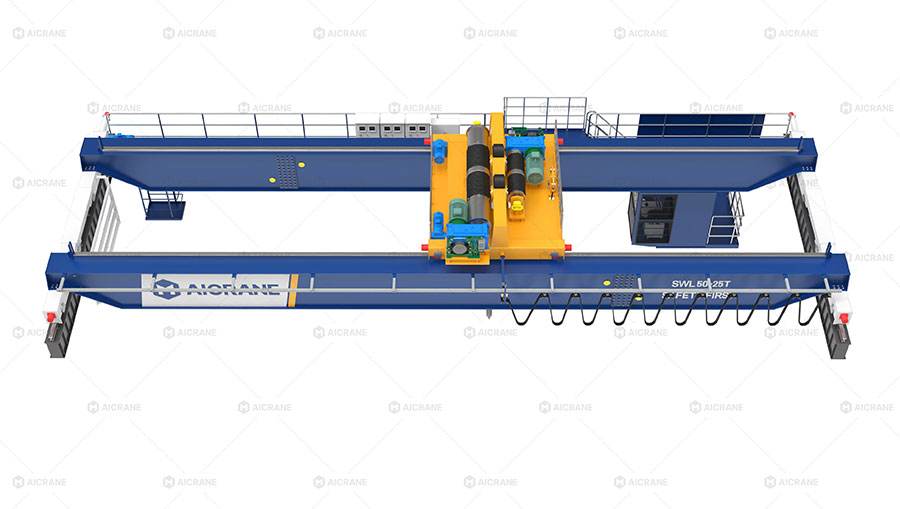
Overview of a 50-Ton Bridge Crane
A bridge crane, commonly known as an overhead crane, is composed of several key components: the bridge girder, end trucks, hoist, trolley, and the control system. In a 50 ton bridge crane, each component is engineered for strength and stability. The bridge girder and end trucks form the main structural framework, designed to withstand high stresses while maintaining smooth movement along the runway rails.
The hoist is the lifting core, typically powered by high-capacity electric motors and equipped with heavy-duty wire ropes or chains, capable of lifting loads up to 50 tons. The trolley enables horizontal movement of the hoist along the bridge girder, and the bridge itself travels along elevated rails or floor-mounted tracks.
While the mechanical design provides the necessary strength, it is the control system that ensures safe operation, particularly under full-load conditions.
The Role of PLCs in Bridge Crane Operation
Programmable Logic Controllers (PLCs) are industrial digital computers designed for automation and process control. Unlike traditional relay-based systems, PLCs offer high flexibility, scalability, and reliability. In a 50-ton bridge crane, PLCs perform multiple critical functions:
-
Real-Time Monitoring: PLCs continuously monitor operational parameters such as motor currents, hoist speeds, trolley positions, and load weight. This real-time data enables the system to detect anomalies like overcurrent, motor overload, or excessive hoist speed before they become hazardous.
-
Load Capacity Management: By integrating load sensors and strain gauges with the PLC, the bridge crane for sale can dynamically measure the actual load on the hoist. If the load approaches or exceeds the rated 50-ton capacity, the PLC triggers alarms, restricts hoist movement, or prevents further lifting to avoid structural overload.
-
Precision Motion Control: PLCs control the acceleration, deceleration, and speed of hoisting, trolley, and bridge travel. Smooth operation reduces load swing, which is critical for preventing accidents, especially when lifting heavy, unbalanced, or awkwardly shaped loads.
-
Safety Interlocks: Safety is paramount in heavy lifting. PLCs manage interlocks that prevent unsafe operations, such as simultaneous movement of the bridge and trolley under certain conditions, or operating the hoist when the bridge position is unsafe.
-
Automation and Remote Operation: PLC systems can integrate with human-machine interfaces (HMIs) or remote control panels, allowing operators to control the crane from a safe distance. Automation functions, such as preset lifting sequences or position limits, reduce human error and enhance operational efficiency.
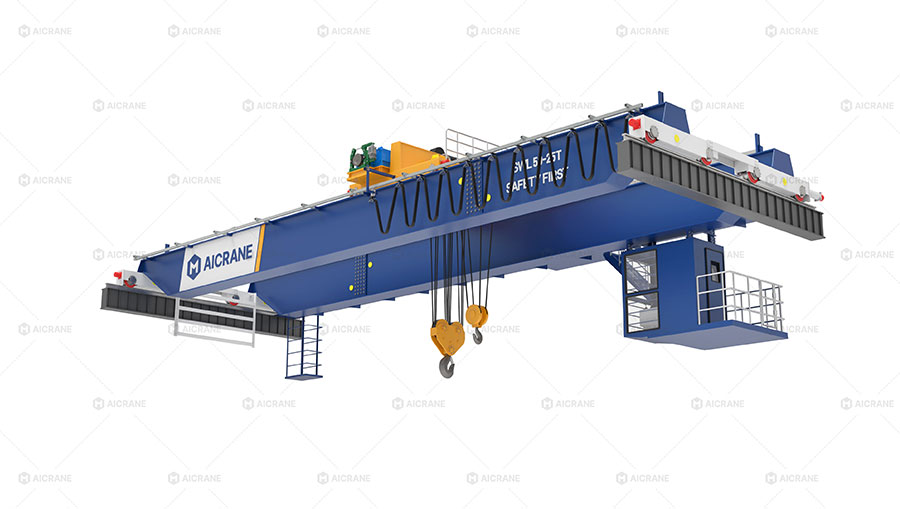
Key Components of a PLC-Based Bridge Crane System
A typical PLC-controlled 50-ton double girder bridge crane system includes the following elements:
-
PLC Unit: The central processor executing control logic, safety checks, and automation routines.
-
Input/Output Modules: Interfaces that connect sensors, limit switches, and control devices to the PLC.
-
Load Sensors and Strain Gauges: Measure real-time load and detect overload conditions.
-
Motor Drives and Inverters: Controlled by the PLC for precise speed regulation of hoist, trolley, and bridge movement.
-
HMI (Human-Machine Interface): Displays crane status, load data, and allows operator input for commands or adjustments.
-
Safety Devices: Emergency stop buttons, limit switches, and overload alarms integrated into the PLC logic.
Advantages of PLC Control in Ensuring Load Safety
Implementing a PLC-based control system in a 50-ton bridge crane provides several critical advantages:
-
Enhanced Safety: Real-time load monitoring, motion control, and safety interlocks reduce the risk of overloading or accidents.
-
Operational Precision: Smooth acceleration, deceleration, and coordinated movement minimize load swing and potential damage to both the load and crane.
-
Efficiency: Automation features, such as preset lifting sequences, increase productivity while reducing operator fatigue.
-
Flexibility: PLC programming allows easy modifications for new operational requirements, load types, or safety standards.
-
Diagnostics and Maintenance: PLCs can log operational data, track usage patterns, and detect system faults early, enabling predictive maintenance and reducing downtime.
Practical Applications
In industries such as steel fabrication, shipyards, or heavy machinery assembly, 50-ton industrial bridge cranes equipped with PLCs handle tasks that would be impossible or dangerous with manual control. For example:
-
Steel Mills: Moving heavy coils and sheets while precisely controlling hoist speed to avoid material deformation.
-
Shipbuilding: Lifting large hull sections and engines while minimizing load sway in confined spaces.
-
Power Plants: Handling turbines, transformers, and other heavy equipment with accurate positioning to fit into installation points.
In each scenario, the PLC system ensures that the crane operates safely within its 50-ton load limit while providing precise movement and control.
Conclusion
As industrial demands increase, the need for safe and efficient heavy lifting becomes ever more critical. A 50-ton bridge crane, while structurally robust, relies heavily on an intelligent control system to ensure safe load handling. PLC-based control provides real-time monitoring, overload protection, precision motion control, and automation capabilities, all of which significantly enhance the safety, efficiency, and reliability of crane operations. By integrating advanced PLC systems, industries can not only maximize crane performance but also protect personnel, equipment, and materials from the risks associated with heavy load handling.
For any facility relying on 50-ton bridge cranes, implementing a PLC-based control system is no longer optional—it is a critical investment in operational safety and efficiency.